
ICE arrests in Wisconsin reach a new peak
Federal immigration authorities are ramping up operations nationwide to meet new daily arrest quotas. ICE agents in Wisconsin have turned to prisons, jails and — increasingly — street arrests to make their numbers.
U.S. Immigration and Customs Enforcement (ICE) records logged more than 2,100 arrests in Wisconsin between Jan. 20, 2025 — the day President Donald Trump returned to office — and the end of July 2026.
The agency recorded 220 arrests in June 2026, up from just 119 over the preceding month.
Records indicate that more than half of those arrested in Wisconsin since Trump’s return to office had prior criminal convictions. Roughly 15% had neither a prior conviction nor a pending criminal charge. Wisconsin is an outlier in that regard. Immigrants without prior convictions or pending charges made up about 40% of ICE arrestees nationwide over the same period. That share has grown in recent months.
ICE has recorded arrests in practically every corner of Wisconsin
The most up-to-date ICE arrest data, obtained by the Deportation Data Project, contains slightly more geographic detail than earlier iterations.
While that geographic information contains inconsistencies, it points to ICE arrests in cities large and small across the state.
Most of those arrests were effectively handoffs between law enforcement and immigration authorities. ICE agents made the bulk of their Wisconsin arrests in prisons — both federal and state — and local jails.
But arrests outside of prisons and jails are also rising.
“Non-custodial” arrests, meaning arrests of people not already in law enforcement custody, spiked in June as ICE expanded its ranks, set more ambitious daily arrest goals and — at least in Milwaukee — ramped up daylight arrests in public spaces.
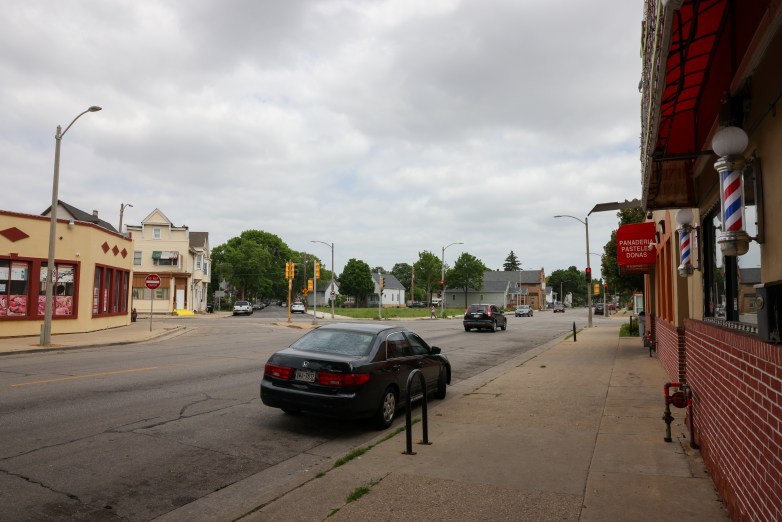
More than half of the roughly 100 people picked up in June’s flurry of non-custodial arrests had no criminal history, including 31-year-old Estenderly Marte Polanco, an immigrant from the Dominican Republic detained during a traffic stop on Milwaukee’s South Side.
But arrests outside of prisons and jails are also rising.
ICE logged its largest tally of non-custodial arrests in greater Milwaukee.
The arrest dataset doesn’t list addresses of non-custodial arrests, with one notable exception: the U.S. Department of Homeland Security (DHS) field office in downtown Milwaukee, where ICE agents routinely arrest immigrants during mandatory check-ins. The office contains a temporary holding room for detainees.
ICE is preparing to move into a new office on Milwaukee’s northwest side, but the federal government extended its lease for the downtown facility — owned by the Milwaukee School of Engineering — through April 2028.
ICE logged its largest tally of non-custodial arrests in greater Milwaukee.
Arrests at the downtown field office frequently outpaced other non-custodial arrests in greater Milwaukee during the first year of the Trump administration’s immigration crackdown.
The balance shifted at the end of 2025.
Most immigrants arrested at DHS’ Milwaukee field office had no criminal history or pending charges, as did a narrow majority of those picked up in non-custodial arrests elsewhere in greater Milwaukee.
DETENTION
ICE keeps a separate database of detention records. While it doesn’t consistently match the agency’s arrest records, it enables Wisconsin Watch to track about two-thirds of immigrants arrested in Wisconsin in the past year as they passed through ICE’s network of detention facilities.
Most of those immigrants first appear in custody at the half-dozen county jails in Wisconsin that contract with ICE to hold immigrant detainees or at the holding room at DHS’ Milwaukee field office.
ICE detention records also offer more granular details about the criminal records of some Wisconsin arrestees with prior convictions, or at least those whom Wisconsin Watch could cross-identify between the agency’s arrest and detention datasets.
The most common infractions on Wisconsin arrestees’ records: driving under the influence of alcohol and other traffic offenses. The two cohorts each account for roughly 13% of all Wisconsin arrestees with prior convictions who appear in ICE detention records. Both outnumber the third-largest cohort — those with prior convictions for drug trafficking — 2-to-1.
State law treats a person’s first drunk driving offense as a civil infraction, not a crime. Wisconsin is unusual in that regard; only New Jersey takes a similar approach to first-time drunk driving offenses, while all other states treat a first offense as a misdemeanor. But Milwaukee-area immigration attorney Jenifer Bizzotto told Wisconsin Watch that some immigration court judges are “treating all offenses, even civil infractions, as violations of criminal law, and therefore indicating someone is a danger to the community” — for instance, not distinguishing between a civil penalty for a first-offense DUI and a conviction for a second-offense DUI.
Wisconsin law also bars undocumented immigrants from obtaining driver’s licenses, so run-ins with law enforcement for driving without a license are common among immigrant communities statewide. Like driving under the influence of alcohol, a first offense for driving without a license is a civil infraction.
Not all ICE detainees passing through Wisconsin were arrested in-state. Federal authorities are using some Wisconsin detention facilities as transfer points — or, in some cases, long-term holding facilities — for immigrants facing removal.
Most arrived from elsewhere in the Midwest, but some detainees have arrived from facilities as far away as south Texas.
Nearly all immigrants who passed through the Douglas County Jail since last January were arrested in other states — primarily during a high-profile, multi-agency enforcement operation in Minnesota’s Twin Cities last winter.
Roughly a third of those who passed through the Dodge County Jail, ICE’s largest contract facility in Wisconsin, were out-of-state arrestees.
DESTINATIONS
Of the roughly 2,170 people arrested by ICE in Wisconsin since Jan. 20, 2025, just over 400 – nearly 20% — still await final rulings in their immigration cases.
Most remained in custody in Wisconsin, Indiana and Kentucky as of early August.
DHS expanded mandatory detention in July 2025.
Some detainees challenged their detention in federal court.
The 7th Circuit rejected the policy
Most are no longer in the United States
Some left through voluntary departure
ICE’s detention data records the final stops of many of those deportees. More than 175 passed through the Broadview Staging Facility in the Chicago suburbs before boarding removal flights at Chicago O’Hare International Airport. Hundreds more last appeared in detention facilities in Louisiana and Texas.
Deportations isn't always speedy.
A Somali man transferred from the Racine Correctional Institution into ICE custody last February passed through nearly a dozen detention facilities over 10 months before boarding a deportation flight in December 2025.
Most Wisconsin deportees returned to their home countries.
Country coordinates reflect the capital of each receiving country, not precise arrival locations.But at least 21 people landed in countries other than their own. The Trump administration has relied on “third country removals” to bypass asylum claims — a maneuver the Board of Immigration Appeals streamlined last fall.
Mexico took in 10 of those arrested in Wisconsin and deported to third countries since Jan. 20, 2025. Most were Venezuelan, Nicaraguan and Cuban citizens.
Immigration authorities deported one Nicaraguan woman arrested in Milwaukee to Nigeria last December. ICE detention records indicate she had no prior convictions or pending charges.
Data note:
Wisconsin Watch analyzed ICE arrest and detention records through Aug. 5, 2026, made available by the Deportation Data Project, a partnership between academic researchers at the University of California-Los Angeles and the University of California-Berkeley.
ICE records are anonymous, incomplete and often inconsistent. Wisconsin Watch approximated arrest locations using the state, city and event_landmark fields in the agency’s arrest records and reconstructed the sequence of facilities where ICE held detainees by tracking unique identifiers assigned to individual detainees. The analysis reflects only arrests and detentions recorded in the datasets as occurring in Wisconsin, meaning the totals may undercount arrests and detentions.